Skills for 2030: How We’re Teaching Students to Outsmart AI?
60-sec Summary
Artificial Intelligence (AI) is changing the world faster than any technology before it. Many parents worry that machines may replace human jobs in the future. But the truth is — the future will belong to people who know how to think beyond machines.
In a world where AI can write an essay in seconds, we aren’t teaching students to compete with machines; we’re teaching them to lead them. We believe education must prepare children not just for exams, but for a world where creativity, critical thinking, emotional intelligence, and problem-solving matter more than memorisation.
That is why, Mount View International School, Dera Bassi has proudly set up its AI Lab — not to replace human thinking, but to help students understand technology, question it, and use it responsibly.
Through hands-on exploration, coding foundations, collaborative problem solving, and creative experimentation, our students learn one powerful lesson: AI is a tool, not a replacement for human intelligence.
Because the goal is not to compete with machines —it is to outthink them. And the skills to do that start in school. We are building the “Human Moat”: the specific set of skills that no algorithm can replicate. This blog explores how we are turning the “AI threat” into the ultimate playground for the next generation of thinkers, creators, and leaders.
Contents of This Post:
The World Our Children Will Graduate Into
Imagine a world where machines can write emails, analyse data, generate images, and even help doctors diagnose diseases. Now, that world is no longer a distant future—it is already here.
Artificial Intelligence is rapidly transforming how we work, learn, and live. Many routine tasks that once required human effort are now automated. Besides, as technology becomes smarter, a common question parents ask is:
“What skills will my child need to succeed in the future?”
The answer is not simply learning more information. In fact, information has never been more accessible than it is today. However, what will truly matter in the coming decade is how children think, question, solve problems, and create new ideas.
So, the students graduating in 2030s will enter a world that demands far more than memorised knowledge. They will need the ability to adapt, innovate, collaborate, and think critically in ways machines cannot.
That is why modern education must evolve.
At our school, best school in Dera Bassi, we believe preparing students for the future means equipping them with the skills that help them work with technology—without becoming dependent on it. Humans have evolved with interdependence because dependence alone does not work well with ‘survival’.
The Skills Machines Cannot Replace
While Artificial Intelligence can process enormous amounts of information in seconds, there are certain abilities that remain uniquely human.
These are the skills that will define the leaders, innovators, and creators of the future, including your child.
Critical Thinking
Firstly, AI can generate answers, but it cannot determine whether those answers are meaningful, ethical, or appropriate in a real-world situation. So, students must learn how to analyse information, question assumptions, and make thoughtful decisions.
Creativity
Secondly, machines follow patterns. However, humans create them.
Innovation—from scientific discoveries to artistic expression—comes from imagination. Therefore, encouraging students to explore ideas freely builds the creativity that drives future breakthroughs.
Emotional Intelligence
Thirdly, understanding emotions, building relationships, and communicating effectively are deeply human abilities. Furthermore, empathy and emotional awareness are essential for leadership, teamwork, and community building.
Complex Problem Solving
Next, real-world challenges rarely have simple answers. So, students must learn how to approach problems from multiple perspectives, test solutions, and refine their thinking.
Collaboration
Finally, the future of work will increasingly involve teams that combine human expertise with technological tools. Hence, learning how to work together, share ideas, and build solutions collectively is crucial.
These skills are what allow people not just to use technology—but to guide it.
Why Schools Must Rethink Learning Today?
For many years, education focused primarily on memorisation and standardised testing. While knowledge remains important, the modern world requires something more dynamic.
Students today must learn how to:
- Firstly, ask thoughtful questions
- Secondly, explore ideas independently
- Thirdly, experiment and learn from mistakes
- Finally, apply knowledge to real-world problems
Additionally, classrooms are no longer simply places where information is delivered. Rather, they are environments where curiosity, exploration, and discovery drive learning.
This shift in education is happening around the world as schools recognise that preparing students for tomorrow means giving them opportunities to engage with technology thoughtfully and creatively today.
Introducing Our AI Lab: Learning Technology the Right Way
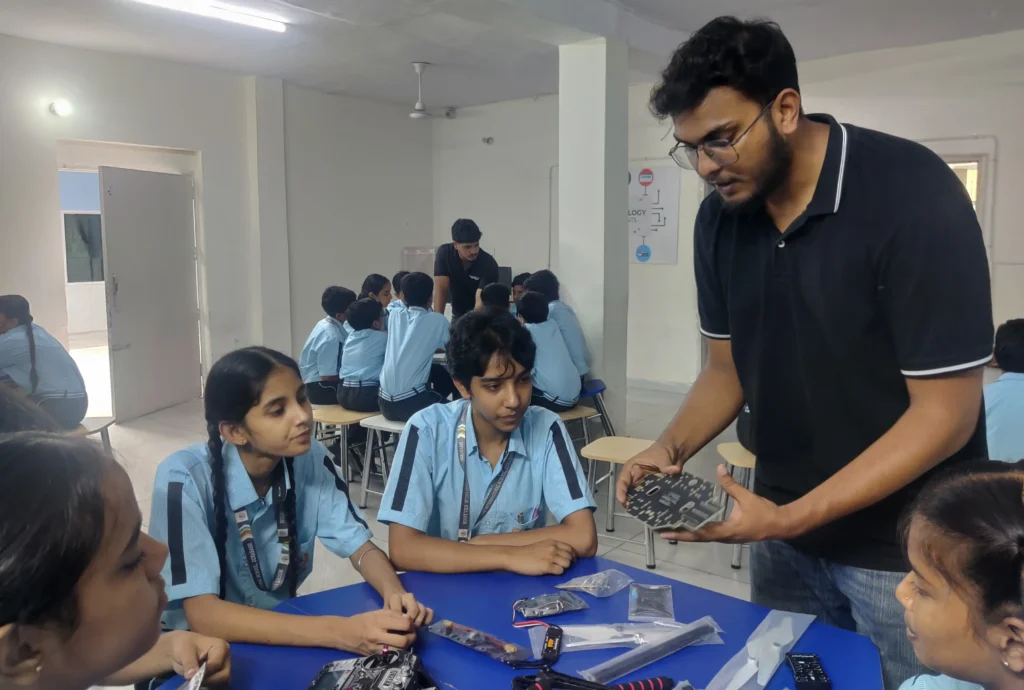
With this vision in mind, our school has introduced a dedicated AI Lab—a space designed to help students explore the world of emerging technologies in an engaging and meaningful way.
The goal of the AI Lab is not simply to expose students to advanced tools. Rather, it is to help them understand how technology works and how it can be used responsibly.
In this space, students learn that Artificial Intelligence is not magic. Instead, it is built on logic, algorithms, and human input.
By demystifying AI, we encourage students to move beyond passive use of technology. Instead, they begin to see themselves as creators, thinkers, and innovators.
Our AI Lab encourages students to:
- Firstly, understand how intelligent systems operate.
- Secondly, ask questions about the role of technology in society.
- Then, explore new ways of solving problems using digital tools.
- Finally, develop responsible habits in the use of emerging technologies.
Most importantly, students learn that technology should empower human intelligence—not replace it.
What Students Actually Do in the AI Lab?
Learning about technology becomes meaningful when students actively engage with it.
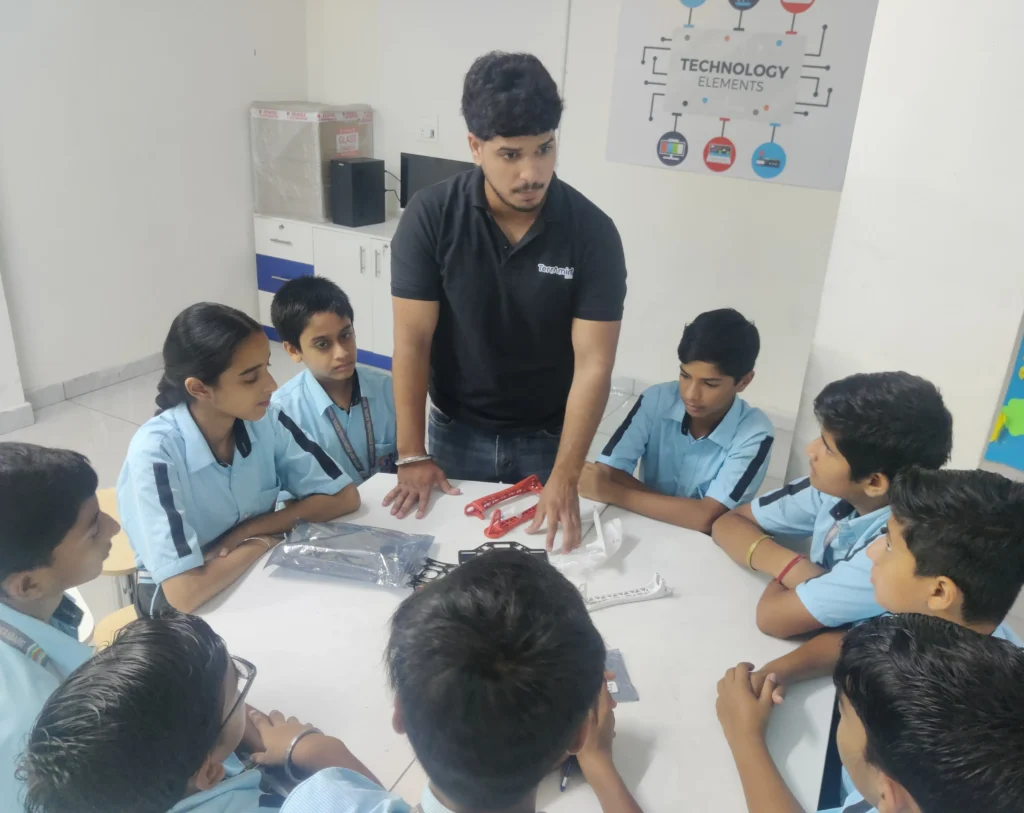
In our AI Lab, students participate in hands-on activities that make complex ideas accessible and exciting. These experiences encourage experimentation, teamwork, and creative thinking.
Some of the learning experiences students explore include:
Understanding Coding Logic
Students begin by learning the fundamentals of logical thinking and coding structures. These activities strengthen reasoning skills and teach them how instructions guide digital systems.
Problem-Solving Challenges
Students work together to tackle challenges that require planning, testing, and revising their ideas—skills that mirror real-world innovation.
AI-Assisted Creative Projects
Students explore how technology can support creative expression. Whether generating visual ideas, designing digital stories, or experimenting with new media, they learn how tools can expand their imagination.
Robotics and Automation Basics
Hands-on projects introduce students to simple robotics and automation concepts, helping them understand how machines respond to programmed instructions.
Conversations About Technology Ethics
Perhaps most importantly, students discuss the ethical implications of AI. Questions such as:
- Should machines make decisions for humans?
- How do we ensure technology is used responsibly?
- What role should humans play in guiding innovation?
These discussions help students develop thoughtful perspectives on the technologies shaping their world.
Preparing Children for Jobs That Don’t Exist Yet
One of the most fascinating aspects of technological change is that many future careers have not yet been fully imagined.
Just a decade ago, few people predicted roles such as:
- AI trainers
- Robotics engineers
- Data ethicists
- Human–AI interaction designers
- Creative technologists
By the time today’s students enter the workforce, entirely new fields will emerge.
The challenge for schools is not to train students for one specific profession. Instead, education must focus on building adaptable thinkers who can navigate change with confidence.
Students who learn how to ask questions, experiment with ideas, and embrace innovation will be prepared to succeed in any future landscape.
The Human Advantage: Why Creativity Will Always Win
Despite the remarkable capabilities of artificial intelligence, machines remain limited by the instructions they receive.
Firstly, they can analyse patterns, but they cannot experience curiosity.
Secondly, they can generate content, but they cannot truly imagine.
Also, they can process information, but they cannot understand the human experience.
That is why the most valuable abilities of the future will always remain deeply human.
Creativity.
Empathy.
Curiosity.
Judgment.
These qualities are what drive progress and shape meaningful innovation.
Schools that nurture these abilities give students the confidence to lead technological change rather than simply adapt to it.
When Your Child Asks a Question AI May Not Be Able to Answer
Artificial Intelligence is incredibly powerful, but it works in a very specific way. AI generates answers based on the data it has already been trained on. So, it looks at patterns from existing information and predicts the most likely answer.
But what happens when a child asks a question that no one has really explored before?
Imagine a curious student wondering:
“If I put oil inside a pressure cooker, will it behave like water? And if not, which oil might behave the most like water?”
This is not the kind of everyday question you might find neatly explained in textbooks or common online searches. AI may try to give a general answer about pressure, boiling points, or cooking oils, but it may not truly address the exact curiosity behind the question.
Because the student isn’t simply asking for information — they are thinking like a scientist.
They are wondering about:
- how liquids behave under pressure
- whether different oils react differently
- what might happen in an unusual experiment
These are the kinds of questions that push knowledge forward, not just repeat what is already known.
And this is where human thinking goes beyond artificial intelligence.
Our Vision with the Introduction of Mount View AI Lab
Future-Ready Students, Not Just Exam Toppers
At our school, academic achievement remains important. But our larger goal is to nurture students who are prepared for a world of constant change.
Lord Krishna said, “Parivartan sansaar ka niyam hai” and truly, change is the only constant. And one important thing is that the time lost will never return. It is the most important asset and that which is irreversible. The easiest available and yet the easiest lost.
We want children to grow into individuals who are:
- Curious about how the world works
- Confident in exploring new ideas
- Responsible users of technology
- Creative thinkers and problem solvers
- Compassionate collaborators
The introduction of our AI Lab is one step in this journey.
It reflects our belief that education should empower students to understand the tools shaping their future and use them wisely.
Because ultimately, the future will not belong to those who fear technology.
It will belong to those who understand it, question it, and use it to create something better.
And that journey begins in school.
At our school, we encourage students to go further than simply asking AI for answers. Through experimentation, discussion, and guided exploration—especially in spaces like our AI Lab—students learn to test ideas, question results, and sometimes even discover something entirely new.
Because the goal is not just to get answers quickly.
The goal is to ask better questions than machines can anticipate.
That is how true learning begins.